
London’s property market is sending two very different signals. House prices are falling, while rents keep rising. According to the latest official figures from the Office for National Statistics (ONS), the average London house price fell 3.3% in the year to July 2026, to £550,000. Over roughly the same period, the average London rent climbed to a record £2,332 a month.
For homeowners, landlords, buyers and renters, this split matters. Here is what the data shows, why it is happening and what it could mean for your next move.
The numbers at a glance
- House prices are down. The average London price was £550,000 in July 2026, compared with £569,000 a year earlier. This is the 11th month in a row of annual falls, and the weakest result of any English region. Across the UK as a whole, prices still rose 1.4% to £273,000.
- Rents are up. The average London rent reached £2,332 a month in August 2026, 3.5% higher than a year earlier and faster than the 3.0% recorded in July. That is almost £80 more a month, or around £950 a year, than in August 2025.
- Homes are slow to sell. Rightmove reports that only 42% of homes listed in London found a buyer in September, compared with 61% nationally.
- There are fewer homes to rent. Zoopla estimates that 6% fewer homes are available to rent in London than a year ago, and 13% fewer in inner London.
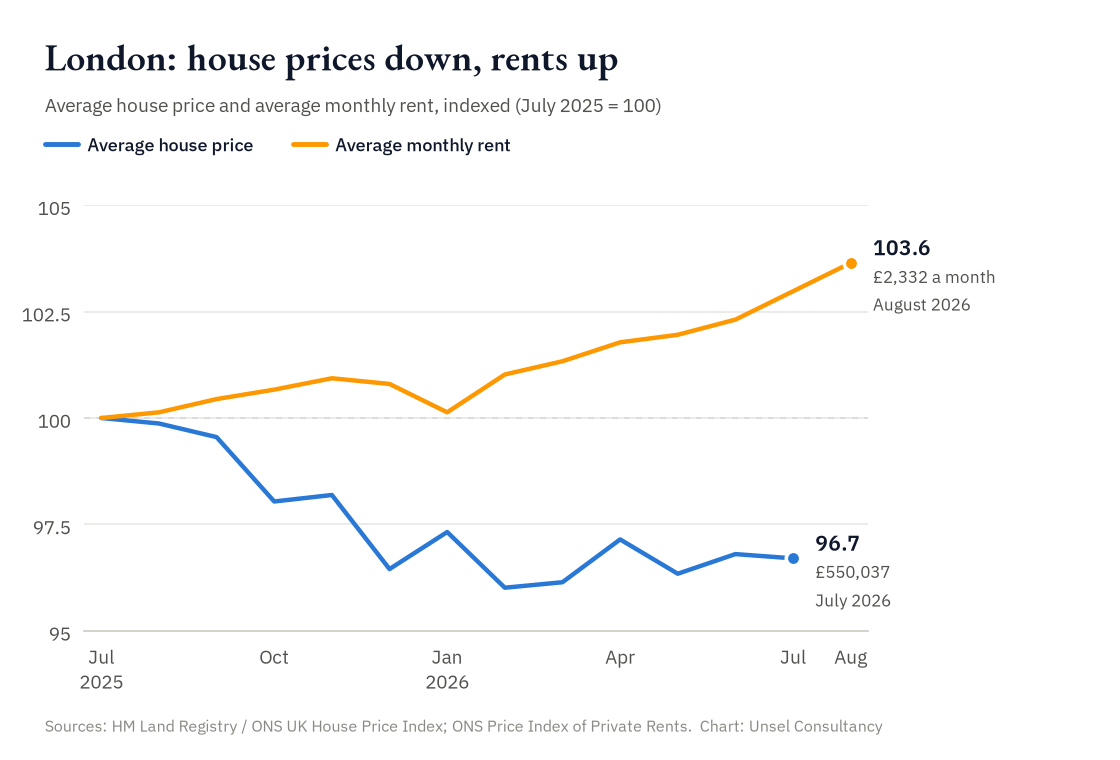
Rent growth in London actually slowed sharply during 2025, from more than 10% a year in January 2025 to about 1% in January 2026. It has picked up almost every month since, just as house prices have continued to slide.
Prime central London has been hit hardest
The falls are not spread evenly across the capital. Provisional ONS figures show average prices down 20.7% in Westminster and 14.1% in Kensington and Chelsea in the year to July 2026. These boroughs have fewer sales, so the figures can swing from month to month, but the direction is clear. Higher value homes also face a new cost: from April 2028, the High Value Council Tax Surcharge will add an annual charge of £2,500 to £7,500 to homes worth £2 million or more.
The split is just as visible by property type. HM Land Registry data shows London flats down 6.6% over the year, while terraced houses were almost unchanged, down just 0.2%. Flats make up a large share of London’s rental stock, so this fits the wider picture of landlords selling up and fewer investors buying.
Why house prices are falling
- Borrowing costs are rising again. The Bank of England held Bank Rate at 3.75% on 17 September 2026, but three of the nine committee members voted for an increase. Inflation rose to 3.1% in August, pushed up by higher fuel and energy prices linked to conflict in the Middle East, and markets now expect rate rises. Average fixed mortgage rates have already moved back above 5%.
- London is the least affordable market. With the highest prices in the country, London buyers feel every rise in mortgage rates the most. Rightmove describes London as the place “where affordability is the most stretched”.
- Moving costs more. Since April 2025, stamp duty starts at £125,000 instead of £250,000, and first-time buyers pay no stamp duty only on the first £300,000, down from £425,000. In London, that affects almost every purchase.
- Buyers have plenty of choice. With lots of homes on the market, sellers have to compete on price, and homes that look overpriced simply sit unsold.
Why rents keep rising
- Fewer homes to rent. Some landlords have sold, and Zoopla reports that new investment in rental homes remains low because of higher costs and greater regulation.
- More people renting for longer. Higher mortgage rates keep would-be first-time buyers in the rental market. Zoopla recorded 5.3 enquiries per rental listing across the UK, the highest level for almost two years.
- A new rulebook for landlords. The Renters’ Rights Act 2025 abolished section 21 “no-fault” evictions from 1 May 2026 and moved tenancies onto a rolling, periodic basis. Its exact effect on supply is debated, but it has added to the costs and responsibilities landlords weigh up.
What it means for you
Homeowners: improve rather than move?
If you need more space, selling in a falling market means accepting a lower price, paying stamp duty on your next home and taking out a new mortgage at higher rates. For many London households, adding space to the home they already own makes more financial sense. A rear or side extension or a loft conversion can add a bedroom or a bigger kitchen without the costs of moving, and it can add value when the market recovers. Most projects start with accurate measured drawings and, depending on the scope, planning permission or a Lawful Development Certificate.
Sellers: stand out from the crowd
With only around four in ten London listings finding a buyer, pricing and presentation matter more than ever. Buyers compare many homes online before they book a viewing, and a clear, accurate floor plan helps them understand a property in seconds. Here is why every listing needs a floor plan.
Landlords: stronger rents, higher expectations
Rising rents and falling prices have improved the rough gross yield on an average London home, from around 4.7% a year ago to just over 5% today (a simple calculation using the ONS average rent and average price, before costs). At the same time, tenants now have more rights and the bar for landlords is higher. Well maintained, well documented homes let faster, and refurbishing between tenancies, improving a layout or adding a bedroom can all lift returns, provided the work is properly planned and approved.
Buyers: more room to negotiate
For buyers who can secure finance, a slower market means more choice and more room to negotiate, particularly on flats. If you are buying a property to renovate, a measured survey carried out as soon as you have access helps you understand the space and price the works with confidence.
What happens next?
Forecasts are uncertain. Zoopla expects UK rent growth to reach 4% to 5% by the end of 2026, while the direction of London house prices will depend largely on interest rates and the Bank of England’s next moves. The next official ONS figures are due on 21 October 2026. Whatever happens, the gap between the cost of buying and the cost of renting in London is likely to shape property decisions for months to come.
How we can help
Whether you are extending instead of moving, preparing a home for sale or upgrading a rental property, Unsel Consultancy provides measured surveys and floor plans, technical drawings and design and planning support across London. Request a quote and we will be happy to help.
Sources
- ONS, Private rent and house prices, UK: September 2026
- HM Land Registry, UK House Price Index: London
- ONS, Price Index of Private Rents: monthly price statistics
- ONS, Housing prices in Westminster and Kensington and Chelsea
- Zoopla, Rental Market Report: September 2026
- Rightmove, House Price Index: September 2026
- ONS, Consumer price inflation, UK: August 2026
- MoneySavingExpert, Base rate held at 3.75% (September 2026)
- House of Commons Library, High Value Council Tax Surcharge